


Health workers battling Ebola in war-torn Congo were driven away from Kpangba displacement camp after locals rejected claims that two women died from the virus two weeks ago.
The camp became the first in the region to record Ebola deaths, prompting teams from the provincial health ministry, World Health Organization and aid agencies to rush in and trace contacts to break transmission chains.
But their efforts stalled as angry residents forced the teams out, denying that Ebola was responsible for the deaths. “They refused to accept that the two women had died from Ebola,” said Jean-Claude Lonzama, chief doctor for the local health zone of Nizi, a heavily populated mining area.
The resistance has deepened fears that distrust could accelerate the spread of the virus in the overcrowded camp.
“Up to this day, we are not able to follow up on the contacts of these cases,” Lonzama told Reuters on Saturday.
The standoff has left health authorities flying blind as they try to stave off a surge of Ebola cases in this camp of around 30,000 people, most of whom have fled inter-ethnic violence in surrounding areas.
“We have 22 displaced persons sites in the Nizi health zone … with around 81,124 residents,” Lonzama said. “This is also our great worry because no preventive measures have been put in place in these sites aside from a few educational messages.”
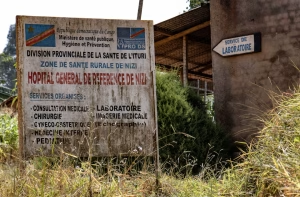
Since the outbreak was declared a month ago, several treatment sites have been attacked by locals angry about not being able to bury their loved ones because of precautions taken to keep the virus from spreading or convinced Ebola is a hoax.
Aid workers fear Ebola could spread quickly in this and other displacement camps, where hundreds of people sometimes share a single toilet and open defecation is common, accelerating the spread of what is already one of the world’s largest-ever outbreaks.
There are more than 5 million displaced people across the three provinces affected by the outbreak – Ituri, South Kivu and North Kivu – all of which have been devastated by decades of conflict.
In Kpangba, as in towns and rural areas across eastern Democratic Republic of Congo where cases have been recorded, health workers trying to contain the outbreak are running up against deep-seated mistrust of the government and outsiders.
The attacks on Ebola treatment sites recall the widespread violence targeting health facilities by civilians and armed groups during a 2018-2020 outbreak in eastern Congo that killed more than 25 health workers.
The deaths in Kpangba occurred on May 31 and June 1, but were first made public in a report by the U.N. refugee agency published on Thursday.
According to a Congolese health ministry report seen by Reuters, the first victim, a 60-year-old woman in the camp, tested positive for Ebola on May 30 but had, by then, broken out of quarantine and could not be located.
Source/REUTERS




